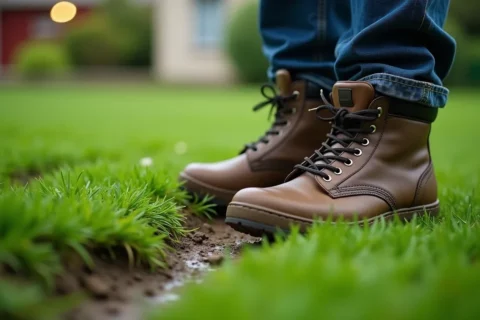


A client calls in October, after the first real rain, and says their kikuyu looks tired. They want it scarified. You arrive to find a surface so hard your boot barely leaves an impression, water pooling in the low spots from the night before, and a root mat you could strike a match on. Scarifying this lawn would be like shaving a man’s head to fix his headache. The machine would bounce, the tines would skate, and six weeks later the client would be on the phone asking why nothing greened up.
The confusion between aeration and scarification costs contractors money and costs homeowners their lawns. The two operations solve different failures, demand different equipment, and happen at different moments in the season. A contractor who cannot tell the difference, or who deploys both machines because the quote was accepted and the trailer is already there, is not offering a service. They are renting noise.
What scarification actually fixes
Scarification attacks thatch, the dense organic layer that accumulates between soil and green leaf. A thin blanket of dead material, under 15 mm, insulates roots and buffers temperature swings. Once that layer swells past 20 mm, it becomes a sponge that repels water, locks out fertiliser, and breeds fungal disease. Kikuyu and buffalo are the worst offenders in this climate. Their stolons and rhizomes grow faster than soil microbes can break them down, especially where nitrogen application is heavy and mowing height is kept too high.
The symptoms are tactile. Walk across the lawn in dry conditions and it feels like a cheap mattress. Press a garden fork down and the tines sink through a yielding mat before they touch anything firm. Lift a 10 cm square with a spade and you will see roots tangled in brown fibre, never reaching mineral soil. Water runs off or sits on top. Fertiliser applications produce a brief flush, then nothing, because the nutrient never reached the root zone. Dollar Spot and Brown Patch appear in the same patches every season, because humidity trapped in the thatch layer never dries.
Scarification tears this material out. Vertical blades set to soil depth cut and rake the mat upward. The lawn looks brutal afterwards. A well-scarified kikuyu in spring will show 30% bare soil. Recovery takes three to six weeks with irrigation and light feeding. The operation belongs to early spring on the Highveld, late August through September, when night temperatures are rising and the grass has time to tiller before summer stress. Scarifying in midsummer kills turf. Doing it in autumn wastes the effort, because recovery slows and winter weed invasion fills the gaps.
What aeration actually fixes
Aeration fixes compaction. Soil particles pressed together by foot traffic, vehicle parking, clay composition, or repeated mowing when wet lose the pore spaces that hold air and water. Roots cannot penetrate. Rain sheets off or stands in puddles. Fertiliser sits in the top centimetre, accessible only to the shallowest roots, so the lawn greens briefly then yellows again. The grass looks hungry because it is suffocating.
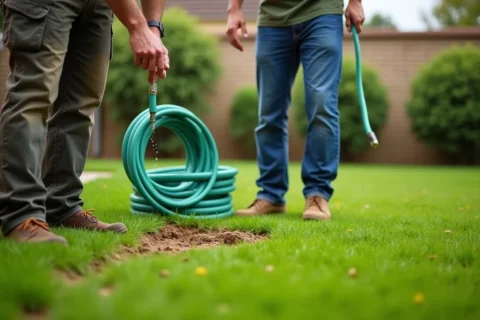
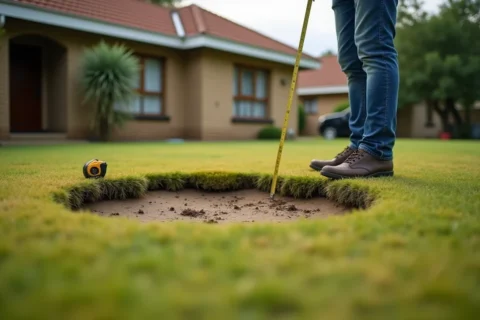
The diagnosis is straightforward and physical. Take a screwdriver with a 20 cm shaft and push it into the lawn. In healthy soil, it slides to the handle with moderate pressure. In compacted clay, common across Johannesburg’s northern suburbs and Cape Town’s southern suburbs, you will meet resistance at 5 cm and need your palm to drive it deeper. The tin-can infiltration test confirms it: a 7 cm ring pressed into the turf, filled to 2.5 cm, should drain in under fifteen minutes. Water still standing after half an hour means the soil structure has collapsed.
Core aeration pulls cylindrical plugs of soil from the root zone, typically 10 cm deep and 15 mm diameter, spaced 10 cm apart. The holes remain open, creating channels for water, oxygen, and root growth. The extracted plugs break down on the surface and redistribute microorganisms. Spike aeration, which merely punches holes without removing material, offers temporary relief on moderate compaction but can glaze the hole walls in heavy clay, worsening the problem over time. For a lawn that sees regular foot traffic or sits on transformed soil where builders compacted the subgrade, core aeration is the only meaningful intervention.
The cost of getting it wrong
Scarifying a compacted lawn strips what little healthy leaf remains and exposes bare soil without addressing the root cause. The turf thins further. Weeds colonise. The client blames the contractor for destroying their lawn, not realising the real failure happened at diagnosis. Aerating a thatch-choked lawn punches holes through the mat without removing it. Water drains through the holes, hits the compacted layer beneath, and runs sideways. The thatch layer remains, still repelling surface irrigation, still harbouring pests. The client sees plugs on the lawn, pays the invoice, and wonders why the grass still feels like a trampoline.
Both errors waste the client’s money and the contractor’s reputation. In a market where a small operator survives on word-of-mouth in a single suburb, one misdiagnosed lawn can cost three referrals. The material difference is not large. Scarification on a 500 m² lawn runs R2,500 to R4,000 depending on thatch depth and disposal requirements. Core aeration on the same area runs R3,000 to R5,000, with a second pass on severe compaction. The contractor who explains why one is needed and the other is not, who shows the screwdriver test or the lifted turf square, earns trust that converts to ongoing maintenance contracts.
How to read a lawn before quoting
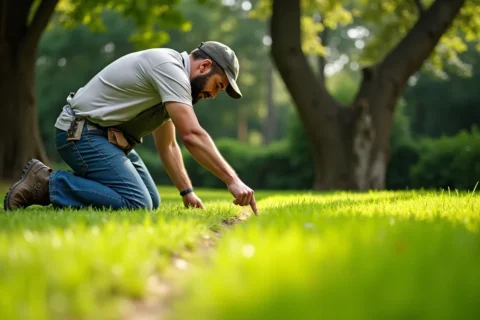
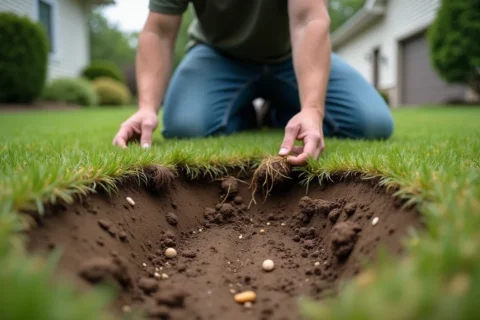
The inspection takes ten minutes and should happen in daylight, with the soil moist but not saturated. Walk the perimeter, then cut a diagonal across the centre. Note traffic patterns: the path to the washing line, the gate the dog uses, the driveway verge where the second car parks. These areas will compact first and deepest.
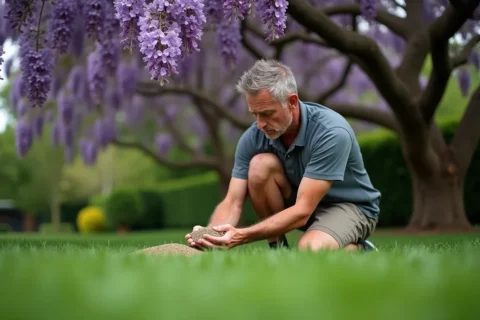
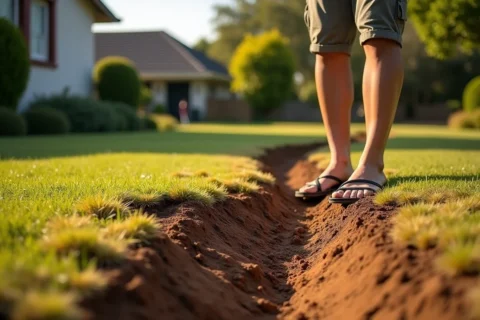
Lift three turf squares with a spade, each 10 cm by 10 cm, from different zones. Measure the thatch layer with a ruler. Over 20 mm and spongy means it is a scarification candidate. Under 10 mm and firm means to check compaction. Push the screwdriver test in five spots. Note depth of easy penetration. Set out the tin can where water pools or where the grass looks thinnest. Time the drain.
If thatch is thick and compaction is moderate, scarify first, then aerate six weeks later after recovery. If compaction is severe and thatch is minimal, aerate and overseed if the season allows. If both conditions exist, which is common on old kikuyu lawns in established suburbs, quote both operations separately with a clear sequence and timeline. Never bundle them into a single “lawn renovation” price that hides what you are actually doing.
Equipment and execution
For scarification, a pedestrian petrol scarifier with vertical blades set to working depth handles up to 1,000 m² efficiently. Stihl and Husqvarna units in the 40 cm to 50 cm cut width range are standard equipment for small contractors. Blade spacing matters: closer spacing at 20 mm removes more material but slows progress. Set depth by testing a 2 m strip and adjusting until blades tick against soil without digging in. Collect debris with a rotary mower on low cut, or rake and bag manually on smaller lawns. Disposal of thatch adds R300 to R600 per load depending on municipal garden waste fees.
For core aeration, hollow-tine machines pull cleaner plugs than solid-tine units. A 50 cm pedestrian aerator with 15 mm tines at 10 cm spacing covers roughly 400 m² per hour. Tandem and MTD units are common in the rental market; most small contractors own by the third season if aeration is actively sold. Soil moisture must be adequate: too dry and tines shatter, too wet and plugs smear. The ideal window is 24 to 48 hours after rain or irrigation, when soil holds together but does not stick.
The conversation with the client
Most homeowners know their lawn is failing. Few know why. The contractor who arrives with a screwdriver and a spade, who lifts a turf square and explains what they are seeing, immediately separates from the operator who quotes from the driveway. Show the client the thatch layer, the shallow roots, the water standing in the tin can. Let them feel the hardness underfoot. The explanation should be physical, not abstract. Not “your soil needs to breathe” but “rain is running off this surface instead of sinking in, and your roots are trapped in the top five centimetres.”
Quote the correct operation. If the client asks for both, explain why one takes priority and what the lawn will look like after. If they want a package price for everything, price it honestly with the sequence specified. The contractor who sells aeration when scarification is needed, because aeration is easier to execute or better margin, is farming reputation for short-term revenue. The contractor who declines the wrong job, or redirects it to the correct service, builds a practice that lasts.
This weekend’s checklist
If you are inspecting lawns now, early spring on the Highveld or late winter in the Cape, carry a screwdriver, a 10 cm ruler, and a tin can with both ends removed. Test three lawns you have already quoted this season. Check whether your diagnosis would hold up to the same inspection you recommend to clients. If you own both machines, review your last twenty invoices. Count how many were bundled “renovation” jobs with no clear primary operation. That number is your misdiagnosis rate, and it is costing you more than the fuel to run the equipment.