
Every contractor who has laid turf in a Johannesburg December has watched a client turn a R12,000 kikuyu installation into straw. The sprinkler runs at midday, evaporating half the water. Or it does not run at all because the client left for Plett. Two weeks later the brown patches appear, and the phone call arrives with the same opening: “Your grass is dying.” No mention of the hosepipe that stayed coiled. No memory of the handover conversation where watering was discussed beside the gate. The contractor now faces a choice: absorb the cost of re-turfing or argue with someone who has already decided the workmanship was poor. This is a documentation problem dressed as a turf problem, not a warranty problem.
A warranty without written client obligations is a bet on someone else’s daily behaviour, and most contractors lose that bet. It is not a promise of quality.
What a Warranty Actually Covers
Workmanship warranties cover what the contractor controls: grade of turf delivered, depth and quality of topsoil, level finish, visible compaction of sod to soil. They do not cover whether a client waters before 10 am under Joburg Water Level 1 restrictions, or whether the domestic worker understands the irrigation timer. Contractors routinely issue blanket “establishment guarantees” of 30 or 60 days without separating these categories. When the turf fails, the dispute becomes a memory contest. What was said at handover? Did the client understand? A verbal explanation beside the driveway dissolves into contradiction within a week.
The Consumer Protection Act Section 54 places a heavy burden here. Consumers are entitled to services performed in a proper manner. Turf that fails to establish looks, to any reasonable observer, like a service not properly performed. Without documented proof that the client neglected watering, the contractor carries the evidentiary burden of proving their own innocence. Small claims courts and social media review platforms do not distinguish between a contractor who cut corners and a contractor who failed to paper their defences.
The Establishment Agreement That Actually Works
A practical establishment agreement is a separate document from the main quotation, signed independently, with its own checklist. It should specify five obligations with enough precision that compliance can be verified.
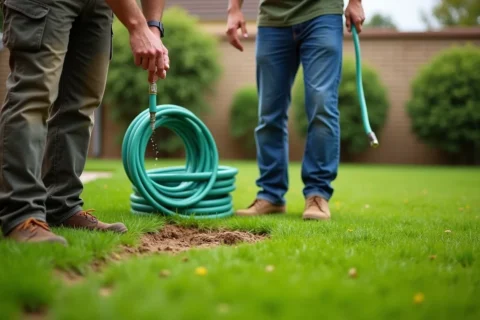
Watering volume and timing. State 20-25mm daily for the first 14 days, which translates to roughly 20-25 litres per square metre. Specify the restriction-adjusted window: before 10 am and after 4 pm where Joburg Water Level 1 applies. Do not write “water regularly.” Write the millimetres, the restriction times, and the method of measurement. A rain gauge or empty tuna tin placed on the lawn during irrigation proves the volume was achieved.
First mowing protocol. For kikuyu (Pennisetum clandestinum) or LM Berea (Dactyloctenium australe), specify no cutting before 10-14 days post-installation, minimum height 50mm, sharp blade mandatory. A client who mows at 30mm on day seven with a blunt rotary mower tears roots and invites heat stress. The agreement should prohibit this explicitly, not vaguely.
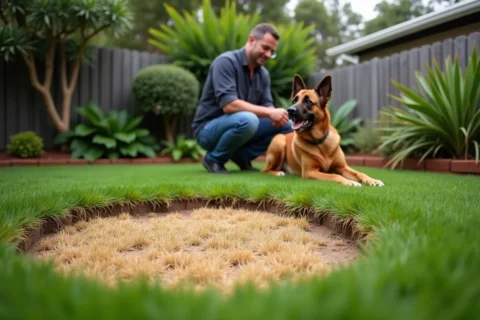
Site access and pet management. Reserve the contractor’s right to inspect during the establishment period without 48-hour notice. Specify no dogs, no garden service foot traffic, no weekend cricket, for three to four weeks. Compaction from a boerboel’s repeated path across sod that has not rooted is indistinguishable from poor soil preparation in its visible effect, but the cause is entirely different.
Problem reporting timeline. Require written notification with date-stamped photographs within 48 hours of any browning, thinning, or pest observation. WhatsApp is acceptable if the response confirms receipt. A client who waits three weeks to mention a problem has allowed a minor irrigation gap to become a dead patch, and the delay itself becomes evidence of their own lapse.
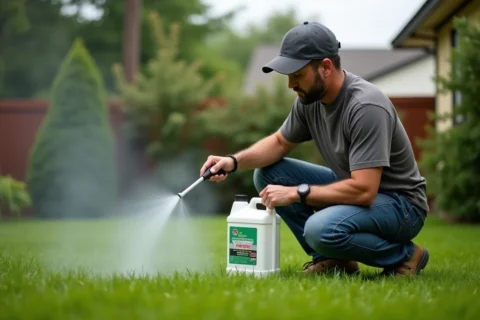
Chemical prohibition. Bar the client from applying fertiliser, herbicide, or pesticide without written contractor approval during the warranty period. Wonder 3:1:5 (25) SR applied too early burns tender roots. A broadleaf herbicide sprayed before the sod has knitted destroys the lawn and voids the warranty. The client must ask first.
How to Document Compliance
Paper the file in three phases. Pre-installation: photographs of existing site conditions, including any faulty sprinkler heads, drainage problems, or exposed roots that preceded the contractor’s arrival. Installation: photographs of turf rolls at delivery showing LGSA-compliant quality, of topsoil spread to specified depth, of the laying pattern. Post-installation: the signed agreement itself, with the client holding the document in a photograph that captures the healthy green turf behind them.
Follow this with digital confirmation. Email or WhatsApp the care instructions with a read receipt or explicit reply. Schedule automated reminders at day seven and day fourteen, linking back to the original instructions. If the client later claims ignorance, the timestamped thread refutes it.
Irrigation checks deserve their own record. Photograph the system test at handover, showing full spray patterns from each pop-up head, even coverage across the area, timer settings visible on the controller. If a head later fails or a zone is turned off, the initial documentation proves the system was functional when responsibility transferred.
What Failure Looks Like When You Have No Agreement
A 100 square metre kikuyu re-turf, including removal of failed sod, new turf at R35-R50 per square metre, labour, and transport, runs R10,000 to R15,000. This is the direct cost. The indirect costs include the labour day diverted from a paying job, the fuel for return visits, the negative Google review that persists for years, and the time spent in small claims court preparation that never reaches hearing but consumes evenings nonetheless.
Without a signed agreement, the contractor who installed perfectly graded turf on properly prepared soil cannot prove the client failed to water. The client who genuinely received poor materials cannot prove the turf was substandard at delivery. Both parties lose. The only winner is the dispute itself, which consumes resources until someone surrenders.
The LGSA code of conduct expects clear written contracts and transparent handover procedures. Members who ignore this risk individual disputes and erode the standard that allows professional contractors to distinguish themselves from fly-by-night operators who disappear after cashing the deposit.
The Warranty Certificate as Conditional Document
Issue the warranty certificate only after the signed establishment agreement is returned. Reference the agreement number on the certificate. State explicitly that warranty coverage is conditional upon adherence to the attached care guide. This transforms the warranty from a blanket promise into a defined exchange: the contractor guarantees workmanship and material quality, and the client guarantees post-installation care. Either party’s failure voids their corresponding protection.
A warranty that omits these conditions is an unlimited commitment to manage someone else’s hosepipe, and no contractor can afford that commitment across thirty, fifty, or a hundred sites each season. It is not confidence in your own work. The client who wants a guarantee should be willing to guarantee their own participation in return. If they refuse to sign, they have already told you what kind of summer it will be.