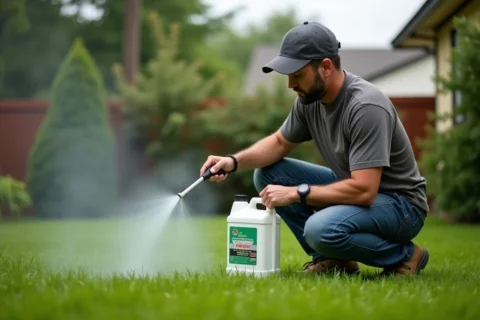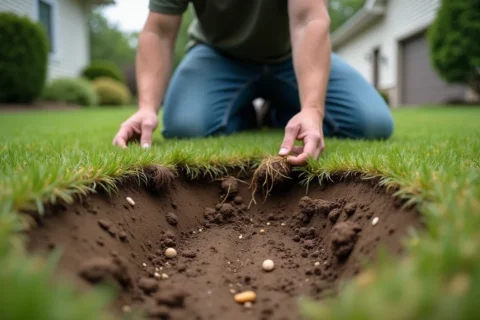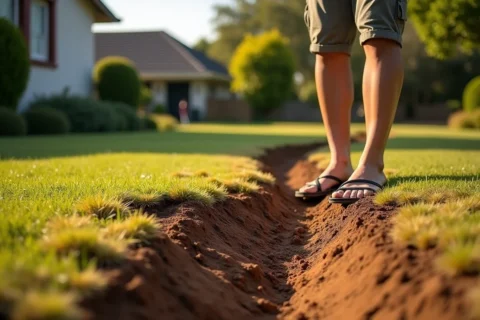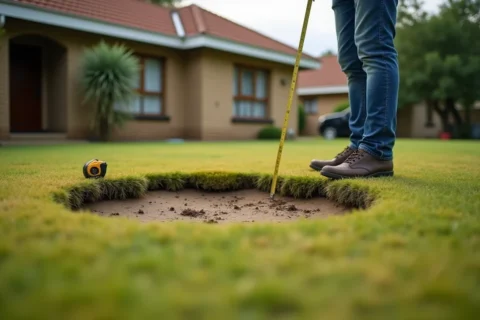

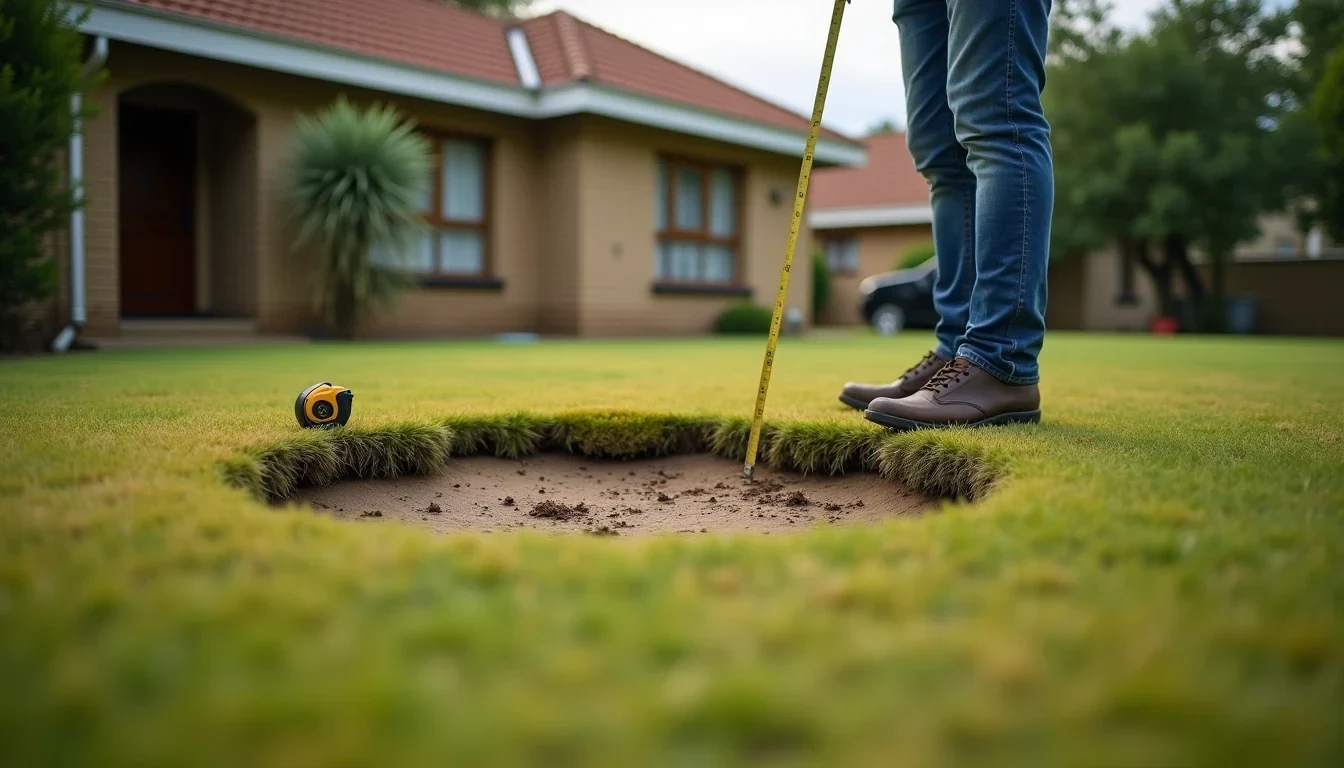
Three cubic metres of washed plaster sand sitting on a flatbed looks smaller than it is. Spread that same pile at 15 mm depth across a 200 m² kikuyu lawn and you have just entombed the growing crowns of every Pennisetum clandestinum plant under a layer they cannot push through. I watched this happen in Benoni two Octobers ago. The homeowner phoned a sand supplier, described his back garden as “pretty big,” and accepted the driver’s suggestion of three cubes. By late November the leaf blades were yellowing at the tips and the lawn had developed a permanent wet patch against the boundary wall. He spent the next season repairing a problem that half an hour with a tape measure would have prevented.
Topdressing belongs to maintenance, not construction. The difference between a level surface and a dead lawn is measured in millimetres and cubic metres.
Know what topdressing can actually fix
What it does for your turf
A thin layer of compatible material fills shallow ruts and divots up to 20 mm deep, giving the mower deck an even plane to follow and reducing trip hazards on buffalo or LM Berea surfaces. After scarification or hollow-tine aeration, the dressing filters into the open holes instead of letting them collapse. This gives new cynodon or kweek roots a porous channel to follow rather than forcing them to fight back through compacted sidewalls. A 5 mm to 10 mm blanket also shields grass crowns from the thermal shock that scorches Highveld lawns in late spring.
Done correctly, the existing blades remain visible after application. You should still see green leaf emerging through the material by sundown. If the lawn looks like a sand dune, you have already crossed into damage.
Where it stops being useful
Topdressing cannot correct major grading errors. Depressions deeper than 50 mm, significant slopes toward house foundations, or drainage reversals are construction problems, not maintenance tasks. Fixing them requires excavation, subsoil fill, compaction equipment, and eventually re-turfing or re-seeding. Attempting to build up large areas with repeated surface applications simply buries the living grass under an ever-thickening layer. The result is the same whether you apply it in one dump or four thin coats over a month: smothered crowns and a lawn that dies from the top down.
Measure before you phone the supplier
Mapping the area
Break the lawn into rectangles, triangles, and circles. For a rectangular section, multiply length by width. For a right-angled triangle, multiply the two perpendicular sides and halve the result. Add every section together to reach your total square metres. If the shape is genuinely irregular, pace out a bounding rectangle and subtract the hardscaping. Do not guess. A 10 m by 15 m lawn is 150 m², not “about a hundred and something,” because suppliers bill by the cubic metre and your wallet notices the difference.
Picking the depth
For routine maintenance after aeration or to smooth minor undulations, work to 5 mm. For more pronounced hollows that still fall within the 20 mm limit, 10 mm is the practical ceiling. In isolated depressions you might touch 20 mm, but only if the surrounding turf is healthy and the grass blades are long enough to remain partly exposed. Anything thicker than that does not dress the lawn; it buries it.
Converting to cubic metres
Multiply your total area in square metres by your depth in metres. A 150 m² lawn at 8 mm needs 1.2 m³. A 300 m² lawn at 5 mm needs 1.5 m³. Order by volume, not by weight. One cubic metre of dry sand weighs roughly 1 500 kg to 1 600 kg, while a compost blend might come in at 1 000 kg to 1 200 kg for the same box. Tell the yard you need 1.2 m³ of a specific blend, not “a ton of lawn sand.” Round up by five or ten percent to account for settling and spreading loss, but resist the urge to add an extra half cube “just in case.” That surplus will sit in a corner and harden, or worse, it will tempt you to spread it anyway and finish the job by killing the grass.
The damage caused by over-application
Suffocation and crown burial
A layer exceeding 10 mm to 15 mm blocks sunlight from reaching the leaf blades. Without light, photosynthesis stops. More critically, the crown of the plant, which sits at or just below soil level, gets buried. This crown tissue generates every new shoot and root. Once it is covered by foreign material, the plant cannot produce replacement growth. The lawn yellows, thins out, and eventually dies back in patches. Thick layers also trap humidity against the surface, creating ideal conditions for fungal problems such as Brown Patch or Dollar Spot, particularly on kikuyu and cynodon during warm wet spells.
Water problems against hard surfaces
Excess material changes the micro-grade against paving, retaining walls, and building foundations. Water that previously sheeted across the lawn now pools against the brickwork or gets dammed behind a new ridge of sand. Over time this alters the drainage pattern you inherited or engineered, potentially pushing moisture toward structures instead of away from them. If the topdressing texture also clashes with the soil beneath, you can create a perched water table where moisture hangs suspended above an impermeable interface instead of draining through. The roots above stay soggy; the roots below dry out.
Match the material to the soil beneath
The single biggest technical mistake after poor measurement is ordering material that fights your existing soil. A coarse sand blanket over heavy clay, or fine silt over a coarse drainage bed, creates a textural discontinuity. Water moves until it hits that junction, then stops. You either end up with a boggy upper layer or a drought-stricken lower profile, depending on which direction the mismatch runs.
A proper topdressing blend for most home lawns contains roughly 70 to 80 percent well-graded sand, 10 to 20 percent organic matter such as compost, and the balance in loam or silt. Institutions like ARC-Roodeplaat and industry bodies such as the LGSA have long emphasised graded sand with uniform particle distribution so that porosity stays consistent across the layer. For ordinary residential jobs, commercial blends sold under labels like Wonder Lawn Dressing or Efekto Lawn Dressing are formulated to approximate this ratio. If you are managing a large estate or sports surface, pay for a soil test and have the yard custom blend to your profile. The cost of the test is less than the cost of repairing a stratified lawn.
Ordering like a contractor instead of a gambler
A truck arriving at your gate with an unplanned heap of sand is not a lawn plan. It is a liability. The supplier is not responsible for your grass; you are. Walk the area with a tape, do the multiplication, and specify the cubic metreage precisely. If the driver suggests adding another half cube because the minimum load is cheaper, decline. Material left over on a residential site almost always gets dumped somewhere inappropriate, or it convinces the spreader to increase the depth and hope for the best. Hope is not a spreading strategy.
This-weekend checklist
1. Walk the lawn and mark depressions deeper than 20 mm with spray paint. These need excavation, not topdressing. 2. Measure every distinct section in metres and total the square metres. 3. Set your depth: 5 mm for general maintenance, 10 mm for minor hollows, 20 mm only for isolated shallow dips. 4. Multiply area by depth to get cubic metres. Add five percent. Phone the yard with that exact number. 5. Check the product spec sheet for sand, compost, and loam ratios before you pay. 6. Spread when the grass is dry and the leaf blades are visible above the material by nightfall.