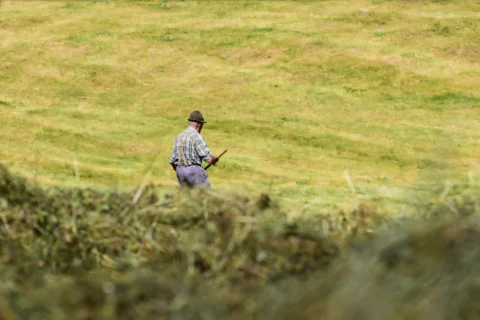


A client once told me he wanted his kikuyu “kept nice.” I quoted him R850 per month for the standard package: mow, edge, weed control, seasonal fertiliser. By July he was on the phone asking why his lawn looked like a wheat field. I drove out to Dainfern and found exactly what I expected: straw-brown kikuyu, dormant, healthy, doing precisely what Pennisetum clandestinum does when soil temperature drops below 10°C. He had pictured Augusta National in January. I had pictured a functional seasonal lawn. The price was the same, but the expectations were not.
“Keep it nice” is the most expensive sentence in residential lawn care. It lets the client fill in the visual with memory and imagination, while the contractor fills in the scope with habit and restraint. The gap between those two inventions breeds disputes, kills margins, and turns good working relationships sour before spring.
What “Nice” Actually Looks Like in Three Tiers
Contractors need to stop accepting aesthetic adjectives and start offering defined finish categories. Every initial site visit should present three options, not one vague promise.
Functional seasonal lawn means the grass is healthy, mowed at correct height, weed-controlled, and free of disease. It also means accepting dormancy. Kikuyu on the Highveld will go straw-brown from May to September. Buffalo in Bloemfontein will yellow and stall. Cynodon in Pretoria will thin and dull. This is not a failure. This is a warm-season grass surviving winter the only way evolution equipped it to. The contractor’s job is to manage the transition, prevent winter weeds from colonising bare patches, and ensure vigorous spring recovery. Nothing more.
Consistently green show lawn means fighting biology with inputs. The grass does not want to be green in June. You must persuade or override it. This demands overseeding with cool-season ryegrass in autumn, typically Lolium multiflorum or Lolium perenne sown at 25-30g per m² directly into the existing sward. It demands elevated irrigation through the dry season, often pushing a household into Joburg Water’s punitive tariff tiers. It demands nitrogen and iron feeding through months when the underlying warm-season grass cannot use it, feeding the overseeded layer instead. The labour, materials, and water carry costs that standard mowing quotes simply do not touch.
Controlled growth near the house is the compromise tier: a smaller show zone around entertainment areas, perhaps 20-30m², with the remainder left to natural dormancy. This contains the cost explosion while giving the client their green vista where it matters most. I have seen this work well on plots in Midrand and estate homes in Ballito. The patio overlooks a managed strip and the rest of the property sleeps through winter without apology.
The Real Cost of Winter Green
Clients who want year-round colour without year-round budget need to see numbers before they sign, not after they complain. A 100m² lawn left to natural dormancy costs what the quote says. The same lawn pushed to winter green bleeds money through three channels.
Water is the silent killer. A dormant kikuyu lawn needs almost nothing from June to August. An overseeded ryegrass lawn needs consistent moisture to germinate, establish, and survive. Joburg Water’s 2023/2024 tariff escalates from R28.32 per kilolitre at the base tier to R54.67 per kilolitre above 30kL. A household already near the threshold can add R500 to R1,000 monthly just keeping ryegrass alive through dry winter weeks. In Cape Town, with its summer-dry Mediterranean pattern, the same logic applies in reverse: keeping cynodon green through January without winter rainfall means irrigation bills that dwarf the maintenance fee.
Seed and fertiliser are more visible but still underestimated. Efekto Evergreen Winter Grass, a common annual ryegrass choice, runs R150 to R250 per kilogram. At 5kg for a 100m² overseed, the initial seed cost alone hits R750 to R1,250. Establishment watering follows. Then monthly feeding with something like Efekto 8:1:5 or Wonder 5:1:5, at R250 to R350 per 5kg bag covering 150-200m², adds another R150 to R300 monthly through the cold months. Labour for the overseeding operation, the extra mowing frequency ryegrass demands, and the spring transition back to warm-season dominance are all additional, all billable, and rarely quoted.
I have watched small contractors absorb these costs to preserve a relationship, then lose the account anyway when the client finds someone cheaper the following summer. The fault lies in the first conversation, not the winter weather.
How to Document the Choice
The contract is your only defence, and it needs to be specific enough to embarrass you if you read it aloud. “Keep it nice” must never appear. Instead, use the tiered language above, with seasonal photographs attached as appendices. Show the same property, same grass type, in three states: summer vigour, natural winter dormancy, overseeded winter green. Let the client initial the image that matches their expectation.
Include a seasonal inputs schedule. For a functional seasonal lawn, this is simple: mowing frequency by month, fertiliser dates, weed control windows. For a show lawn, it must detail the overseeding window (autumn, before soil temperature drops below 15°C), the irrigation minimums in mm per week, the feeding programme, and the spring transition protocol when ryegrass must be stressed out and kikuyu encouraged back. Price each element separately. Let the client see that winter green is a subscription service, not a default setting.
For body corporate and estate work, this documentation becomes essential. A trustee who approved a R12,000 monthly maintenance budget in October will face questions from owners who see brown common areas in July. The contract should specify which areas, if any, receive overseeding, which remain seasonal, and who pays the water tariff premium. I have seen estates in Fourways where the contractor was blamed for “killing the lawn” when the body corporate voted down winter irrigation costs to save on levies.
The Regional Truth Nobody Wants to Hear
Warm-season grass behaviour varies sharply across South Africa, and contractors must calibrate their explanations to local reality. On the Highveld, dormancy is total and predictable. Kikuyu in Johannesburg will brown by late April and stay brown until September. No amount of fertiliser changes this; only temperature and day length matter.
In KZN coastal zones, Buffalo and kikuyu may retain some green through winter, but growth slows dramatically, and the visual shift is less shocking. The same “keep it nice” instruction produces different misunderstandings here: clients expect summer growth rates in June, and contractors deliver June growth rates in June, and both feel cheated.
The Western Cape brings its own complication. Cynodon and kikuyu face winter cold and wet, but summer drought can trigger dormancy too. A client in Somerset West who saw green lawns through winter may see brown ones through January if municipal restrictions bite. The contractor must explain that dormancy has two triggers, not one, and that “nice” is a moving target tied to rainfall and regulation as much as to temperature.
Fix Your Quotes This Weekend
If you are quoting new work this month, pull your last three contracts and search for aesthetic language. “Well-maintained,” “presentable,” “tidy,” “nice.” Delete every instance. Replace with one of the three tiers above, priced accordingly.
Photograph your own sites through the seasons. Build a portfolio of kikuyu dormancy, Buffalo recovery, cynodon spring green-up. These images are more persuasive than any verbal explanation, and they travel with the contract as evidence of what was discussed.
Finally, price the show lawn tier high enough that some clients decline it. This is not lost revenue. It is accurate scope definition. A client who cannot afford winter green must be protected from imagining they already bought it. The contractor who learns this, and learns to say it out loud before the pen touches paper, keeps the account for years. The one who nods and hopes for the best is replacing clients every season, wondering why the industry feels so hard.