
A client phones on Thursday afternoon. Their kikuyu was fine when you cut it Tuesday morning. Now it looks like someone took a strimmer to the back corner. They want to know what you did wrong.
You did nothing wrong. You have about forty-eight hours before a small patch becomes a re-turfing job, and the first thing you say will determine whether that client trusts you in March or finds someone else.
What Actually Happened
Armyworm larvae feed at night and during cool, overcast weather. A single mature larva consumes nearly all its lifetime food intake in its final two to three days of development. A colony of Spodoptera exempta or Spodoptera frugiperda can strip a 100 m² lawn bare in two to five days. The client sees the result, not the process. They see brown where green was, and they see your invoice from Tuesday.
The damage appears as irregular patches of closely cropped or completely defoliated turf, expanding outward from the initial strike point. It does not yellow from the tips down like drought stress, nor does it follow the mower lines like scalping. The grass blades show ragged, chewed edges rather than clean cuts. In early infestations, young larvae scrape away only the green tissue from one side of the blade, leaving a translucent membrane called window-paning. This is your earliest visible warning, and it means you still have time.
How to Check Before You Accuse the Weather
When you arrive on site, resist the urge to diagnose from the driveway. Walk the entire lawn systematically. Note where the damage starts and stops, whether it follows any pattern, and how the transition looks between healthy and affected areas. Armyworm damage has ragged, advancing edges. Drought stress has diffuse boundaries. Scalping follows your own tyre tracks.
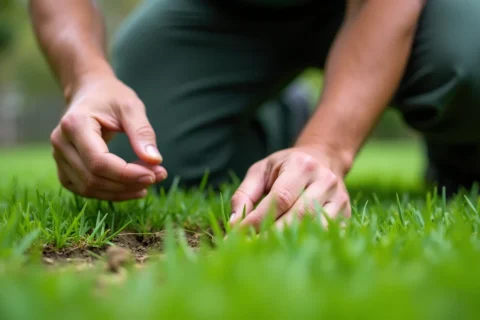
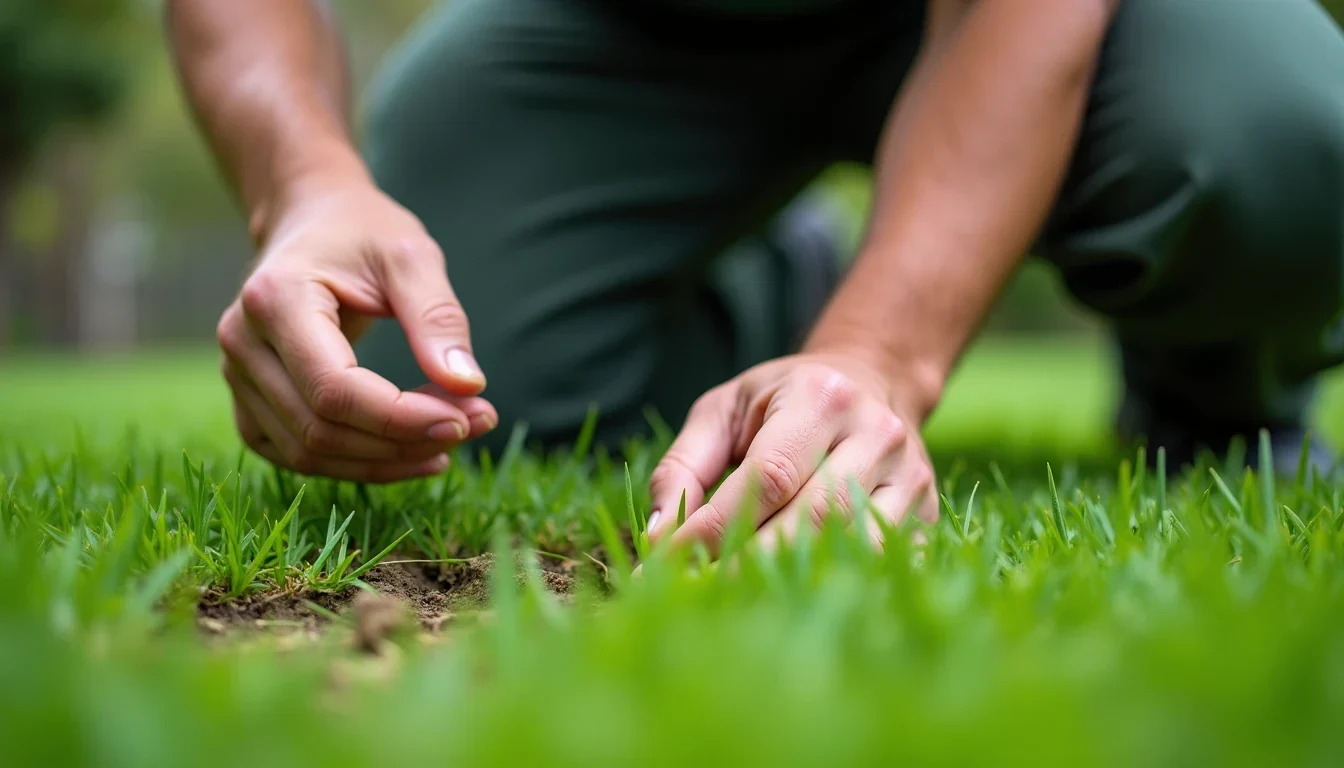
Kneel down and examine individual blades in the damaged zone and in the green turf immediately adjacent. Look for window-paning on blades that still have partial green tissue. Look for frass: small, dark green to black pellets resembling coarse sand or sawdust, caught in the thatch or on surviving leaf surfaces. Frass means active feeding. No frass means look again, or look elsewhere.
The definitive check is the soap drench. Mix 15 to 30 ml of ordinary dishwashing liquid into 4.5 litres of water. Pour it evenly over one square metre at the edge of a damaged patch, where larvae are most likely still actively feeding. Wait five to ten minutes. The soap irritates the larvae and forces them to the surface. Count what emerges. First and second instar larvae are 1 to 2 cm, grey-green to brown, with faint striping. Mature larvae reach 4 cm, and the African armyworm carries a prominent dark dorsal stripe with lighter lateral stripes. If you get twenty larvae surfacing in one square metre, you have a severe infestation. If you get none, expand your test to another zone before ruling armyworms out.
Part the grass with your hands and inspect the thatch layer and soil surface directly. Larvae hide here during hot daylight hours. Check soil moisture while you are at it. Dry, hard soil with firmly rooted but desiccated blades points to drought. Loose turf that lifts like a carpet points to white grubs feeding on roots. Raised tunnels with soil mounding point to mole crickets. Armyworm-damaged turf stays firmly anchored until the blades are completely consumed.
What the Damage Is Not
Drought stress develops over days to weeks. The grass yellows uniformly, often following sun exposure or irrigation patterns. Blades shrivel and dry but are not consumed. The soil is powdery. Deep watering often revives it within forty-eight hours. Armyworm damage does not revive with water because the tissue is gone.
Scalping from too-low mowing exposes the crown and causes immediate browning along the mower path. Dull blades leave frayed, torn tips that brown over twenty-four to forty-eight hours. Neither produces frass nor larvae under soap drench. The root system is intact and the turf does not lift.
White grubs, the larvae of scarab beetles, sever roots at 3 to 5 cm depth. The lawn browns in irregular patches, but the blades themselves are untouched. The key test is the lift: grubs destroy the anchor, so the turf rolls back with minimal resistance. You will find C-shaped, creamy larvae in the root zone, not striped caterpillars in the thatch.
Misidentification costs money and credibility. Applying insecticide to drought-stressed turf wastes R400 to R800 in product and labour, delays the actual solution, and leaves the client with dead grass and a receipt. Re-turfing a failed 100 m² lawn runs R5,000 to R15,000 at R50 to R150 per square metre installed. The contractor who diagnoses correctly on the first visit saves both.
What to Tell the Client
Document everything before you speak. Photograph the damage pattern, the frass, the larvae you surfaced, the healthy adjacent turf for contrast. Note the date, time, weather conditions, and your test results. This protects you from blame and gives the client something concrete to understand.
When you explain, be specific. “The lawn was intact when I left Tuesday. Between then and your call, armyworm larvae consumed the leaf tissue. Here is the frass they left. Here are the larvae I found with a soap test. This is biological, not mechanical, and it is not related to the cut height or blade sharpness.” Show them the window-paning on surviving blades if the infestation is still early. Show them the mature larvae if it is late.
Outline the treatment timeline. Young larvae die with standard contact or ingestion insecticides. Mature larvae may need a second application. The product choice depends on grass species, local availability, and whether the client has pets or children using the lawn. Cypermethrin-based products are widely available through agricultural co-ops and garden centres, typically R150 to R350 per litre of concentrate, sufficient for several thousand square metres at label rates. Biological options using Bacillus thuringiensis var. kurstaki work well on young larvae but require precise timing and thorough coverage. Cost runs higher per application but spares beneficial insects.
Emphasise that armyworms march. A treated lawn can be re-infested from an untreated neighbour within days. The client should monitor daily for two weeks, and you should schedule a follow-up inspection before the next regular service.
Preventing the Next Phone Call
Armyworm outbreaks follow warm, humid conditions after drought stress. This occurs from October through March on the Highveld, and year-round in KZN coastal and Lowveld regions. Irrigated lawns in dry spells are particularly vulnerable because the grass stays soft and succulent while surrounding areas desiccate.
Contractors on weekly service contracts should train crews to spot window-paning during every cut. A two-minute soap drench check on any lawn showing unusual thinning takes less time than a return visit for damage assessment. Crews should note excessive bird activity on a lawn, as birds feed on larvae and often reveal infestations before human eyes do.
Homeowners between visits should understand that a weekly service contract does not restrict pest problems to Tuesdays. Larvae do not consult the schedule. The client who phones on Thursday with early symptoms gets a quick rescue. The client who waits until the following Tuesday to mention brown patches gets a renovation quote.
This-Weekend Checklist for the Contractor
If a client has phoned with sudden damage, do this before Monday. Walk the lawn with a bucket of soapy water and a camera. Run the soap drench on three separate square metres: one in the worst damage, one at the edge, one in apparently healthy turf nearby. Count and photograph every larva that surfaces. Check ten random blades for window-paning. Lift the turf in one spot to rule out grubs. Write one paragraph of findings with timestamps. Phone the client with the diagnosis and proposed treatment before they phone someone else.
If no client has phoned yet, brief your crew leads on window-paning and frass this Saturday. The outbreak you prevent is cheaper than the one you cure.