
Your kikuyu goes yellow in patches, so you reach for the fertiliser bag. That reflex costs South African homeowners millions of rands every spring, and most of it gets poured straight down the drain. The green flush arrives in ten days, the client pays the invoice, and six weeks later the same patches are back, now with added fertiliser burn around the edges. I have watched this cycle repeat across Joburg’s northern suburbs, Cape Town’s Atlantic seaboard, and every housing estate in between. The problem was never hunger. It was shade, compaction, a sprinkler head blocked since 2019, or mole crickets eating the root mat at 3cm depth while the owner chased nitrogen ghosts.
Fertiliser is the easiest sell in lawn care because it delivers visible proof. A contractor spreads 30g/m² of 8:1:5, the client photographs the result, and everyone feels competent. Nitrogen-driven growth without addressing the actual constraint is debt, not progress. The turf grows faster, demands more mowing, builds more thatch, and still fails at the same limiting factor. Granular synthetic applied to dry or stressed turf pulls moisture from leaf tissue through osmotic stress, leaving brown scorch marks that outlast any green-up. In the Highveld’s October heat, I have seen R400 of Efekto Lawn Booster turn a struggling lawn into a patterned rug of green and dead brown.
How to Read What Your Lawn Is Actually Telling You
Start with the failure mode, not the product label. Yellowing in full sun points to different causes than yellowing under a jacaranda canopy. Patchy color following irrigation lines suggests water distribution problems. Uniform yellowing after a dry spell usually means drought stress, not nutrient deficiency. The diagnostic discipline is simple: observe before you treat, and record what you observe with enough detail that you can defend your recommendation when the client asks why you did not fertilize.
Shade: The Light Budget Comes First
Kikuyu (Pennisetum clandestinum) needs six to eight hours of direct sun daily. Drop below four hours and it thins regardless of how much nitrogen you pile on. The leaves elongate searching for light, the internodes stretch, and the turf becomes sparse and weedy. LM Berea (Dactyloctenium australe) tolerates moderate shade better but still has limits. Buffalo (Stenotaphrum secundatum) will persist in deeper shade yet never achieve the density clients expect from kikuyu photographs.
Confirm by mapping shade patterns across a full day. A north-facing wall in the southern hemisphere casts different shadows than clients assume. Trees mature; canopies expand. I have returned to sites where a lawn thrived in 2018 and failed in 2024 because a fever tree doubled its spread. The fix is not feed. It is pruning for light penetration, grass replacement with an appropriate species, or accepting that lawn is the wrong plant for that space. Fertilizing shade-thin kikuyu produces soft, etiolated growth that fungal pathogens colonize within weeks.
Compaction: When Roots Cannot Breathe
Heavy clay soils, construction traffic, and repeated foot paths squeeze pore space from the root zone. Oxygen levels drop, water perches instead of percolating, and roots stay shallow and stunted. The lawn looks hungry, yellows, and responds poorly to irrigation. Fertilizer salts accumulate in the compacted layer because water does not carry them through, increasing osmotic stress and burn risk.
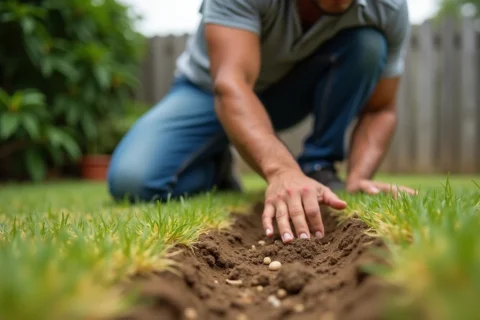
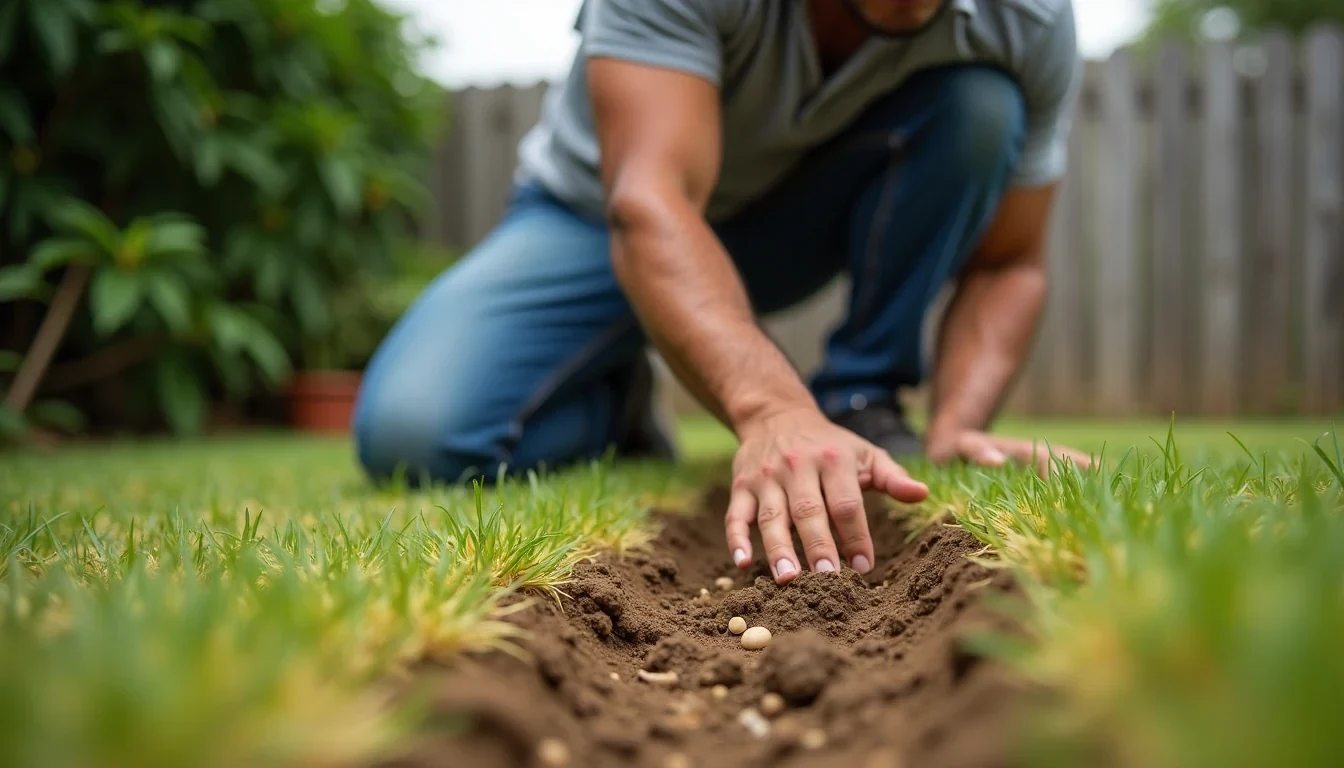
Test with a soil probe or long screwdriver. On healthy loam, you should push 15cm without meaningful resistance. Stop at 4cm on compacted clay. Extract cores to check root depth, thatch thickness, and whether a hardpan sits below the surface. Core aeration with hollow tines, done when soil moisture allows clean extraction, fixes what fertilizer cannot. For severe compaction on Highveld clay, I schedule aeration in March when temperatures moderate and autumn rains assist recovery. Fertilizer comes after, if soil tests show actual deficiency, never before.
Irrigation: Follow the Water
Uneven coverage is the most common hidden cause of patchy lawns I encounter. A single blocked sprinkler head, a pressure differential across zones, or a system designed before mature tree roots invaded the lines all produce dry spots that read as nutrient problems. The client sees yellow, assumes hunger, and demands feed.
Run the system through a full cycle while you watch. Place straight-sided cans across the zone to measure distribution uniformity. Note runoff on slopes, misting from over-pressurized heads, and dry wedges between throw patterns. Check whether the client runs the system long enough for water to penetrate to root depth. In sandy Cape soils, 15mm applied twice weekly may leach past roots before uptake. In KZN coastal loam, the same schedule waterlogs. Adjust depth and frequency to soil texture and season, then verify with a probe. Fertilizer applied to drought-stressed turf or unevenly watered lawns concentrates where water concentrates, burning some patches and starving others.
Soil Chemistry: Test Before You Guess
pH outside 6.0 to 7.0 locks up phosphorus, iron, manganese, and other nutrients regardless of soil reserves. I have seen lawns on acid Highveld soils with phosphorus levels that would grow maize, yet the turf shows deficiency symptoms because aluminum toxicity and low pH make that phosphorus unavailable. Liming fixes the problem over months. Fertilizer does not.
A proper soil test through agricultural extension or a reputable lab costs under R500 and saves multiples of that in misapplied product. Sample at 10cm depth, composite across the lawn area, and request pH, phosphorus, potassium, and organic matter. For recurring iron chlorosis on buffalo in alkaline soils, foliar iron chelate addresses the symptom while you plan longer-term pH adjustment. Guessing with general-purpose fertilizer wastes money and delays proper treatment.
Pests and Disease: Do Not Feed the Enemy
Armyworm larvae, mole crickets, and root-feeding nematodes all produce yellowing, thinning, and patchy decline. Fungal pathogens like Dollar Spot and Brown Patch create discrete lesions or circular patches. Fertilizer helps none of these. High nitrogen actually worsens many fungal diseases by producing succulent tissue with thin cell walls, and rapid growth outpaces the plant’s own chemical defenses.
Inspect damaged areas closely. Tug test for root-feeding insects. Flood a suspect patch with soapy water to drive mole crickets to the surface. Check leaf blades for fungal mycelium in early morning dew. Send samples to ARC-Roodeplaat or a plant pathology service when you are uncertain. Treat the identified pest or pathogen with the correct product at the correct timing. Feed only after recovery is established and tests show genuine deficiency.
The Contractor’s Record: Your Only Defence
Every treatment must be documented with product name, analysis (NPK ratio), application rate in g/m², total area treated, date, and weather conditions. I use a simple field book, photograph each bag label, and note irrigation status at application. This is not bureaucracy; it is survival.
Clients remember outcomes selectively. The lawn declined in January, they fertilized themselves in February, March rains arrived, and by April they attribute recovery to their own intervention while blaming your October treatment for intervening problems. Without records, you cannot separate correlation from causation. You cannot prove that drought stress or their own overwatering caused the damage they now describe. With records, you can show that you applied 25g/m² of 5:1:5 on 12 October following 15mm irrigation the previous evening, that soil temperature was 18°C, and that their own sprinkler audit from March showed 40% distribution uniformity on the south zone where yellowing persists.
For body corporate contracts and estate management, this documentation becomes essential for renewal negotiations. I present annual treatment logs with outcome photographs tied to specific dates. When a trustee claims the lawn never looked worse, I can show that his own estate’s irrigation contractor replaced three broken heads in November, two weeks after my final autumn feed, and that recovery tracked water pressure restoration, not fertilizer timing.
This Weekend: Run the Diagnostics
Walk your site or your client’s site with a probe, a notebook, and the irrigation schedule. Map shade patterns. Test penetration resistance. Run the sprinklers and place cans. Submit one composite soil sample if you have never tested. Photograph every problem area with context, not close-up. Only when you have identified the limiting factor, confirmed it with observation or test, and addressed it appropriately, should you open a fertilizer bag. The green-up that follows will be real, durable, and defensible. The money you do not waste on unnecessary feed pays for the aeration hire, the soil test, or the irrigation repair that actually fixes the lawn.