

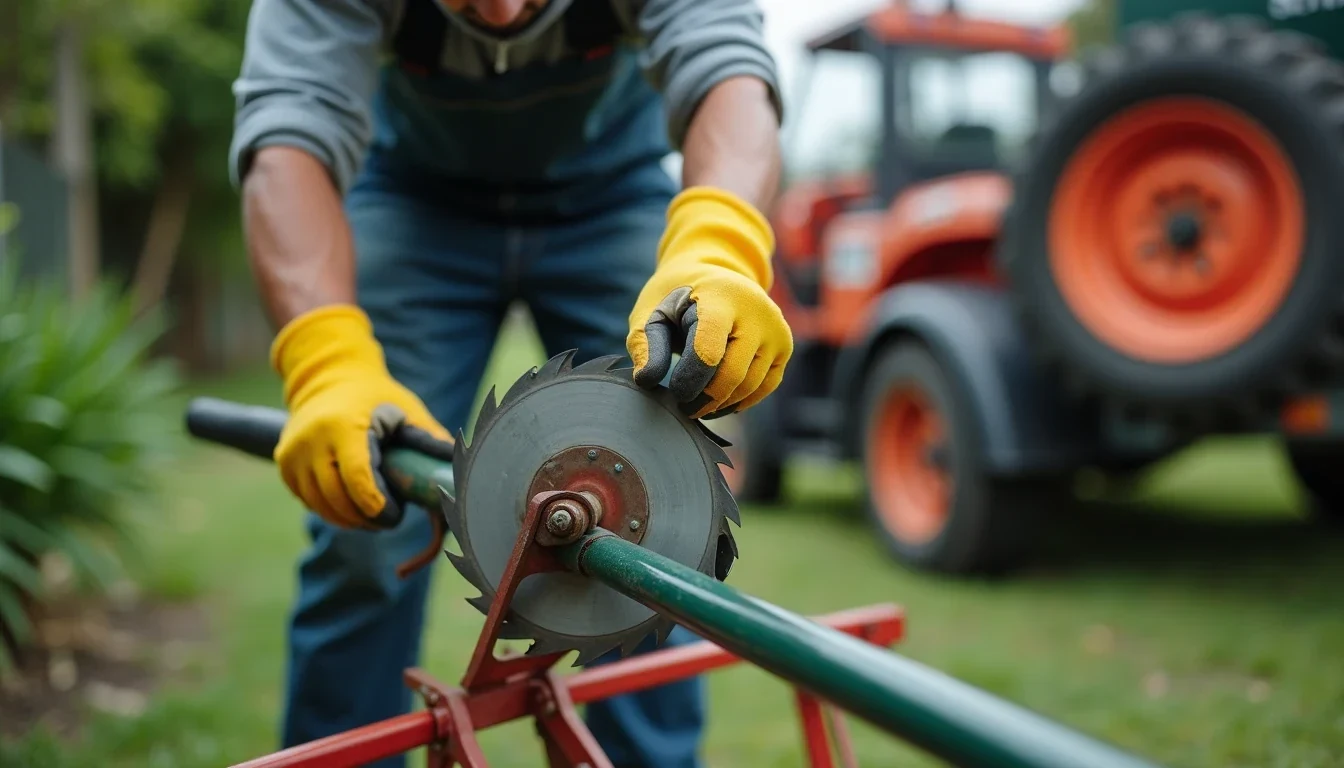
Your blade does not have to be broken to do damage. It only has to be blunt, and on a busy route that is enough to turn a clean cut into a row of browned tips, angry phone calls, and a client who starts wondering why the lawn looks tired two days after you left.
A contractor can lose a morning to workshop work. That is annoying. The real problem is the lawn behind the machine. A dull blade tears the leaf instead of cutting it, and once you start seeing that shredded finish on kikuyu, buffalo or cynodon, the complaint usually arrives before the cause is obvious.
What a blunt blade actually does
A sharp rotary blade slices the leaf cleanly. A blunt one drags and rips. The edge of the grass is left ragged, the cut surface dries out fast, and the lawn takes on that washed-out, heat-stressed look even when irrigation has been fine.
On kikuyu, the damage is easy to spot because the whole sward starts to look grey-brown at the tips within a day or two. The lawn still has density, but the finish is ugly. Clients do not describe it in turf language. They say it looks dry, hacked up, or neglected. If the route includes LM Berea or buffalo, the problem is the same, just less obvious at first because the leaf is broader and the damage takes a little longer to read from the gate.
A torn edge also opens the door to disease. In humid stretches, especially along the KZN coast, a ragged cut creates a better entry point for fungal problems such as Dollar Spot and Brown Patch. The grass is already under stress from losing moisture through the damaged tips, so the plant spends energy repairing wounds instead of pushing healthy growth.
Frayed leaf tips expose more surface area, so the lawn loses water faster than it should after mowing. On a week when the municipality is already tight on supply, or the owner is watching every litre, a bad cut can make an otherwise manageable lawn look as if it has been under-watered for days.
How to spot the problem before the complaint lands
What it is
A blunt blade is not always a blade you can see with a lazy glance. Nicks, rolled edges, slight bends and loss of balance all cause the same ugly finish. Hitting edging bricks, stones, roots or hidden metal on one property can ruin the edge, and the machine will keep producing the same poor result on the next nine stops if nobody checks it.
How to confirm
Start every route with a pre-run inspection. Look for chips, bends and obvious dulling before the mower leaves the trailer. If you wear gloves, run a careful finger test along the edge. You are not trying to shave skin off your hand. You are checking whether the edge still feels crisp or has gone rounded.
After any solid impact, stop and inspect again. A rock strike, a concealed sprinkler fitting, a buried bit of wire or a protruding root is enough to change the cut quality immediately. If the blade has any visible damage, swap it out before the next property. Waiting until the end of the day means one bad blade turns into ten bad lawns.
The visual sign in the field is the same across most lawns. The grass does not look neatly trimmed. It looks torn. The tops go pale or brown fast, usually within 24 to 48 hours. Clients often blame heat or irrigation first because the result resembles drought stress. That guess is wrong often enough to waste a whole argument.
How to treat it
Treat a suspect blade as a service item, not an optional extra. Pull it, sharpen it, balance it and put a fresh set back in circulation. If the impact was hard enough to leave a dent, do not pretend a quick touch-up will rescue it. A bent or uneven blade shakes the whole deck and starts eating spindle bearings, belts and crank components.
Keep a proper balancer on hand. An Oregon 42-047 or a similar tool pays for itself quickly if you are running commercial gear. An unbalanced blade creates vibration, which turns a cheap sharpening job into an R800 to R1,500 spindle bill.
For sharpening, a 40 to 60 grit flap disc on an angle grinder does the job if the hand is steady. A dedicated commercial sharpener is better if you are running enough volume to justify it. Hold the original cutting angle, usually around 25 to 30 degrees for most rotary blades, and remove as little metal as possible. You are restoring an edge, not reshaping the whole blade into a thinner and weaker version of itself.
The maintenance system that stops this from becoming a weekly disaster
Build a rotation, not a reaction
The cleanest setup is simple: one blade set on the mower, one sharpened and ready, one waiting in the queue. If you are running two mowers, that means at least four to six spare sets sitting ready in the workshop. That sounds excessive until you hit a rock on a route in the middle of a packed Tuesday and still have fourteen gardens left to finish.
Label the sets A, B and C, or any other system that makes sense to the team. Then log them. Keep a basic sheet, paper or digital, that records which set is on which machine, when it was last sharpened, and roughly how many hours it has worked. If the same blade keeps coming back damaged, you will see the pattern. If you do not track it, you are guessing.
Store the spare sets on a wall rack, clean and dry. A light film of lubricant such as WD-40 helps slow rust, especially if the workshop sits in a damp coastal area. A rusty spare is not a spare. It is clutter.
Set a sharpening rhythm
For commercial use, blades should be sharpened every 8 to 10 operating hours. For a contractor doing 10 to 15 properties a day, that can mean a sharpening interval every day or two, depending on the size of the sites and how long each cut takes. If you are servicing a lot of sandy or gritty lawns, especially where mowers pick up fine debris, the edge will go off faster.
Do not wait for performance to collapse before you act. A good blade can go dull gradually enough that the team only notices once the finish drops across the whole route. By then you have already paid for the mistake in call-backs and awkward conversations.
What the bad blade costs you
Workshop time is the smallest line item here. The hidden bill is the one that shows up in the route.
A single complaint can cost R250 to R500 once you count labour, petrol and the lost slot in the day. If one blunt blade spoils the finish on ten properties, that is not a small equipment problem. That is a route problem, a service problem and a reputation problem all at once.
Then there is churn. Lose one client on a R400 monthly contract and you are down R4,800 over a year. Lose three or four because they think your finish is sloppy and your margins start bleeding in the background.
Fuel does not help. A dull blade makes the engine work harder, and fuel use can rise by 10 to 15 percent. If a crew burns through 10 litres of petrol a day at around R25 a litre, that is an extra R25 to R37.50 daily, or roughly R500 to R750 a month. Nobody notices it in one fill-up. Everyone notices it when the month-end numbers are ugly.
The problem spreads quietly. One blunt blade can ruin the cut on a whole route before anyone in the truck realises the finish has gone bad. By the time someone spots the pattern, the complaints are already in motion.
What to do this weekend
- Inspect every blade set in the workshop for nicks, bends and rounded edges.
- Set up a one on, one ready, one in queue rotation for each mower.
- Sharpen and balance every set that has done 8 to 10 hours.
- Label blade sets clearly and start a usage log for each mower.
- Put a blade balancer, grinder or sharpener, and a spare set in the vehicle kit.
- Add an immediate impact check to the route routine, especially after stones, roots or metal strikes.
- If a blade takes a hit, swap it before the next property.